
LENA at the NAPS 2025 in Hartford, USA
The 57th North American Power Symposium (NAPS 2025) took place from October 26–28, 2025, in Hartford, Connecticut, USA. Under the theme “Resilience and Intelligence in Future Power Systems,” the symposium brought together researchers, engineers, and industry professionals to discuss emerging technologies that will shape tomorrow’s power grids.
As one of the leading annual conferences in North America on power and energy systems, NAPS provided a vibrant platform for exchanging ideas, presenting current research, and strengthening international collaboration. Technical sessions, panel discussions, and multiple networking opportunities allowed participants to explore new perspectives on data-driven grid operation, artificial intelligence, and advanced communication architectures.
Contributions
Arpit Shah represented the LENA Chair with the paper “Real-Time Hybrid State Estimation Using Modern Communication Infrastructure for Grid Resilience,” co-authored with Eric Glende and Prof. Martin Wolter.
The study presented an integrated Hybrid State Estimation (HSE) framework that combines PMU data (IEEE C37.118) and SCADA telemetry (IEC 60870-5-104) through an Apache Kafka–based streaming architecture. Using an OPAL-RT/HYPERSIM real-time simulator and an IEEE 14-bus test system, the researchers validated how synchronized measurements and modern communication pipelines can significantly improve network observability and real-time situational awareness. The results demonstrated the potential of such architectures in enhancing the resilience of future transmission systems under dynamic and faulted conditions.
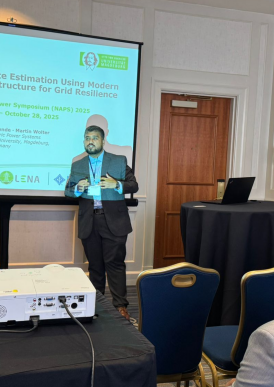 Arpit Shah during his presentation.
Eric Glende also represented the LENA Chair with the contribution “Integrated Communication Protocols for Substation Automation: HiL Validation of IEC 61850, IEEE C37.118 and IEC 60870-5-104,” co-authored by Tommy Christopher Gaede, Eric Glende, and Prof. Martin Wolter.
The work showcased a comprehensive Hardware-in-the-Loop (HiL) validation environment integrating three core communication standards used in modern substation automation. By combining IEC 61850 GOOSE and MMS, IEEE C37.118 synchrophasor streaming, and IEC 60870-5-104 SCADA communication, the study evaluated interoperability, latency behavior, and response times during realistic fault scenarios. Supported by an OPAL-RT digital real-time simulator and protection IEDs, the results highlighted the importance of unified communication architectures for wide-area protection, fast disturbance detection, and automation in next-generation grid control systems.
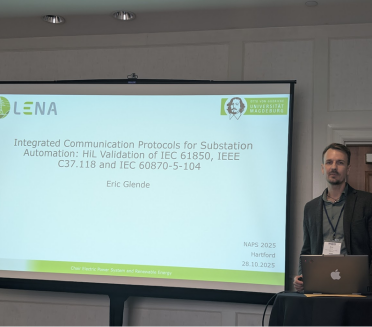
Eric Glende während der Präsentation seines eingereichten wissenschaftlichen Beitrags.
Conference Highlights
The symposium opened with interactive breakfast networking sessions that encouraged open dialogue among researchers and practitioners, followed by a super panel focused on artificial intelligence for Distributed Energy Resources (DERs). The discussions covered a broad range of emerging topics, including AI-based forecasting and uncertainty modeling, microgrid integration within large-scale power networks, data-driven resilience analysis using PMU measurements, probabilistic outage prediction through machine-learning techniques, and the role of agentic AI in automating decision-matrix processes. Experts also shared insights into regulatory developments supporting the integration of new digital technologies, advances in fuel-cell applications such as clean hydrogen systems implemented at major airports, and recent progress in digital-twin technologies for power plant simulation, particularly updates from OPAL-RT. The first day concluded with a formal three-course conference dinner featuring a musical performance by Dr. Zongji Wang and a keynote delivered by John D. McDonald. The second day continued with panel sessions across various specialized themes, award ceremonies recognizing outstanding junior researchers, and concluding discussions that emphasized ongoing efforts to enhance the resilience and intelligence of future power systems.
Acknowledgment
The LENA Chair expresses sincere appreciation to the organizers of NAPS 2025, especially Dr. Zongji Wang, for the excellent coordination and support—including invitation facilitation and on-site arrangements. The Chair also acknowledges Prof. Martin Wolter for his guidance and Eric Glende for his continuous collaboration across both contributions. Participation in NAPS 2025 highlights the LENA Chair’s commitment to pioneering research in real-time monitoring, protection, and control, and to shaping intelligent, secure, and resilient power systems for the future.